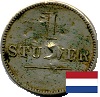
I'm pleased to be able to kick off the month this month. The Panama Pill that I ordered turned up today. The "pill" is a 2½ cent coin and was called the pill because of its tiny size. It's only 10mm. For those of you that can't picture that. Here it is beside a US dime
It really is a thing of beauty (despite what my awful scanner will try to tell you
Well I thought it was going to be a quiet November, but I didn't realise that most of the stuff I bought/swaps I'd organised in October would be turning up in November. I checked the mail this evening and found this waiting for me
Two swaps and 3 things I'd bought.
The parcel and one of the letters was some Australian and Fijian silver from my favourite seller
One of the swaps
The other swap
And the last letter was a NZ trade token. It's unfortunately been roughly cleaned on one side while the other is still nicely toned and untouched.
but there are enough differences to keep them both. The first one is a clipped planchet and is ↑↓ while the new one is ↑↑. There are also small differences in the design; compare for example the urn and cherubs (especially the legs).
here's my latest two. The Morgan is for my type set, and 1951 Florin was an upgrade, which I am happy with as my Australian coin in my world collection.
At a collectors fair in London yesterday and purchased the following coin.
Turkey. 5,000,000 Lira 2001. KM#1110. Only 1,583 made.
Photographs will follow when I return home
Photographs below.
Just paid for 2 auctions: French India Mahé Fanam and Chinese Empire Cash (Qianlong, Boo-yuwan, Type F2, New branch)
Administrateur du catalogue, référent de nombreuses nations antiques et de la Lorraine.
Catalogue administrator, numerous Antique nations and Lorraine referee.
Happy to know that Peter liked my previous post (the two Brock tokens). Here are a few more acquisitions from today:
I posted an "Oak Hall" token last month (additions for October). This one completes the pair since the deadline is Oct. 1899 (the other was Nov. 1899). I know, I know, I should have bought this one in October, and the other one in November, but that's not how it works in the real world.
The two George V coins are not high grade, but I don't want to spend too much on the year by year decimal series, being more interested in colonial coinages.
Obviously these letter punches were made by someone skilled enough, but not a professional metal worker. For this reason there is a faint hope that C D is linked to the F D countermarks in Trinidad. There is no C D countermark listed in Brunk.
Since Clinton won't be our next president, I've decided to buy a coin with some of the money I was going to use to buy an AR in case she tried to reimplement the assault weapon ban.
Well, the only holes i could fill in my collection were the 20 Rappen 1899 and 1/2 Franken 1931, but I did find the first coin myself. the second one was a gift from my mother for helping her out in the garden.
And of course tons of coins I already have, but some of them were in a great condition and are valuable.
Here are the finds: 20 Rappen 1899 (rare) Those rolls are all uncirculated coins from 2014
And the rest of them:
Except for the silver coin, all those coins were found by me.
The best thing about collecting is finding the coins, but not if you have to buy them.
It's very fortunate that many of us in the former British colonies have such tokens as part of our numismatic past, otherwise we would have virtually nothing recognizable as "ours" before the introduction of official coinages. An official NZ currency happened only in the 1930s, right? And in Australia, in 1910.
For anyone who does numismatic research, tokens are, IMHO, much more interesting than the official coinages that came later. One who knows how to use the web and electronic archives can still find unknown facts about the people who put out those tokens.
It seems, too, that the more stable your politics are, the more boring your coinage is.
If you like coins, medals and tokens with ship motives follow my new instagram account with regular updates @numisnautiker
From time to time I sell some coins on Ebay make sure to follow me @apuking on Ebay.
Administrateur du catalogue, référent de nombreuses nations antiques et de la Lorraine.
Catalogue administrator, numerous Antique nations and Lorraine referee.
If you like coins, medals and tokens with ship motives follow my new instagram account with regular updates @numisnautiker
From time to time I sell some coins on Ebay make sure to follow me @apuking on Ebay.
These additions are not to be compared with the spectacular postings of the last few days... Still, if history is important to numismatics, then social history is as well, and we can learn much about "regular" people and local economic activities from such merchant tokens:
By far the most desirable of these is the Hudson's Bay Cº 5¢ token redeemable at their store in Yorkton, Saskatchewan.
The three GOOD FOR TWO LOAVES tokens are interesting because they were holed or stamped over the word TWO after the purchase of one loaf. Axis of the stamped token: ↑→ ; of the two others: ↑↑ approximately. For more information, follow this link.
Most of these tokens, if I'm not mistaken, go back to the 1920s-1940s.
I was going to hold out and save my money up to get a type I standing Liberty quarter in a very high grade, as befits this most beautiful of American coins. But on a whim I looked through my local coin shop's box of them and absolutely fell for this one. Graded F-12, with deep and even toning and a beautiful iridescent rainbow ring of album toning on the obverse. Maybe I'll upgrade some day, but I loved the color of this one so much that I jumped.
Administrateur du catalogue, référent de nombreuses nations antiques et de la Lorraine.
Catalogue administrator, numerous Antique nations and Lorraine referee.
I have some similar coins, do you know what coins I have?
Am I right to say that the 2nd coin is from ca. 1500 ?
I am not an expert in asian coins myself.
The best thing about collecting is finding the coins, but not if you have to buy them.
While October was very eventful (and expensive), November has been somewhat light...
Germany, Third Reich: 1941 Meissen Porcelain Medal (Scheuch-1874iv)
Obv: EINNAHME VON KRETAG - 20. MAI - 1. JUNI 1941; Relief map of Crete between swastika and fasces
Rev: SIEG DER FALLSCHIRMJÄGER-LUFTLANDETRUPPEN UND FLIEGER; Aircraft and parachutes landing
The scene portrays one of the greatest aerial invasions in history. Many historians argue that the delay of the Third Reich in Crete played an important role in the invasion of Russia as the heavy winter hindered their chances of conquest.
Samanid: Mansur I (961-976 CE) AR Multiple Dirham Mule, NM, ND (Album-1465/Album-1465A)
A mule struck with two reverse dies
Byzantine Empire: Andronicus II Palaeologus with Michael IX (1282-1328) Æ Assarion, Constantinople (Sear-2435; DOC 677-680)
Obv: Bust of Archangel Michael
Rev: Half-length figures of Andronicus to left, and Michael to right, either side of Christ standing who crowns the emperors
Sarabhapuriyas of Maha Kosala: Prasannamitra (ca. 525-550 CE) AR Unit (ACR-904)
Obv: Garuda standing facing with wings outstretched, cresent moon and chakra at left, sun and sankh at right; in lower region, Brahmi legend: Sri Prasannamitra, kalasa below
Rev: Incuse image of obverse design
Satavahanas: Gautamiputra Satakarni overstruck on Nahapana (c. 78–102 AD) AR drachm (Pieper-682)
Obv: Three-arched hill, wavy line below, Brahmi legend around reading (rano gotamiputasa) siri satakanisa
Rev: Satavahana symbol
I have some similar coins, do you know what coins I have?
Am I right to say that the 2nd coin is from ca. 1500 ?
I am not an expert in asian coins myself.
Please open a topic in the Identification forum for the last one which doesn't seem Chinese. For others, this will be easier.
On the left pics from left to right and top to bottom:
Qianlong Boo-yuwan Type B Hartill#22.253
Jiaqing Boo-yuwan Type B2 Old branch Hartill#22.490
Jiaqing Boo-chiowan Type A3 North branch Hartill#22.452
Daoguang Boo-gui Hartill#22.602
Administrateur du catalogue, référent de nombreuses nations antiques et de la Lorraine.
Catalogue administrator, numerous Antique nations and Lorraine referee.
A couple more tokens came in today, 20 and 5 made beavers, aluminum:
They cannot be dated later than 1922 since in that year the Labrador District was merged with the St. Lawrence district to form the St. Lawrence Labrador District (for which tokens were also produced).
Again, like some of my previous posts, the interest of these tokens is not in their attractiveness but in their high historical value. In terms of currency unit, too, the "made beaver" is, I would dare to say, a rather unusual and interesting currency.
Fun fact: No African nation has ever issued "made beavers" coins or tokens.
Did not win 18 of them, so only got these 2 additions tonight ...
'Scarce brass medallion: The Duke of Cumberland Defeat of the Jacobites 1746'
A Highlander, r., kneeling in subjugation before a rampant lion, crowned. Ex. 1746. /
Bust of the Duke of Cumberland to right, armoured, and with sash over left shoulder.
GVLIELMVS· DVX· CVMBRIAE· Brass. 31 mm.
'French bronze Art Nouveau medal by Ch. Pillet. Saving Bank'
On the edge: Bronze + Cornucopia / Signed: Pillet
Diameter: 32 mm / Weight: 15.78 Grammes
A few tinies but oldies for my core collection in Austria this month, not much addition to the total silver weight :
A Salzburg Friesach pfennig, ca 1200.
Tyrol kreuzer under Maximilian I, ca 1500
Salzburg uniface zweier, dated 1550
Salzburg uniface pfennig under Archbishop Raitenau, this is more 1600
I like the Salzburg Friesach Pfennig in particular. Impressive find.
Administrateur du catalogue, référent de nombreuses nations antiques et de la Lorraine.
Catalogue administrator, numerous Antique nations and Lorraine referee.
Yes, thanks, I know - which is why I put reproduction below the images of
that and the other coin; the title was what the seller gave. I got them as a
temporary purchase until I can get a real one.
Citeer: "ZacUK" Yes, thanks, I know - which is why I put reproduction below the images of
that and the other coin; the title was what the seller gave. I got them as a
temporary purchase until I can get a real one.
1 ─ The famous Devins & Bolton countermark on an 1854 US large cent;
2 ─ My last missing one-a-year (no varieties) Canadian large cent (1891 large leaves, large date), though two or three could be upgraded; note the planchet flaw on the reverse;
3+4 ─ 1926 and 1927 small cents.
Citeer: "Camerinvs"Nice mix!
I received this yesterday:
Obviously these letter punches were made by someone skilled enough, but not a professional metal worker. For this reason there is a faint hope that C D is linked to the F D countermarks in Trinidad. There is no C D countermark listed in Brunk.
Hi Camerinvs, I tend to read G D and not C D. Would that make a difference?
At this point I am more interested in assessing the possibilities. The two letter punches were not created by a specialist, but he was someone who had some knowledge of (and the tools for) the art of blacksmithing. There is a faint possibility that some other specimens of the same stamp exist, and perhaps an even fainter possibility that the punch originated from Port of Spain, Trinidad, like the similar-looking F D punches from there. It would be quite a luck if the "D" punch was also known from one of the many variants of the "F D" punches, but I will need to get a copy of Lyall's Caribbean Tokens book and also compare with all examples I can find online (e.g. those offered at auctions) to know for sure.


 :
:


 ). See there if you don't yet know the link